A genetic analysis system that turns raw DNA data into reports a clinician can sign.
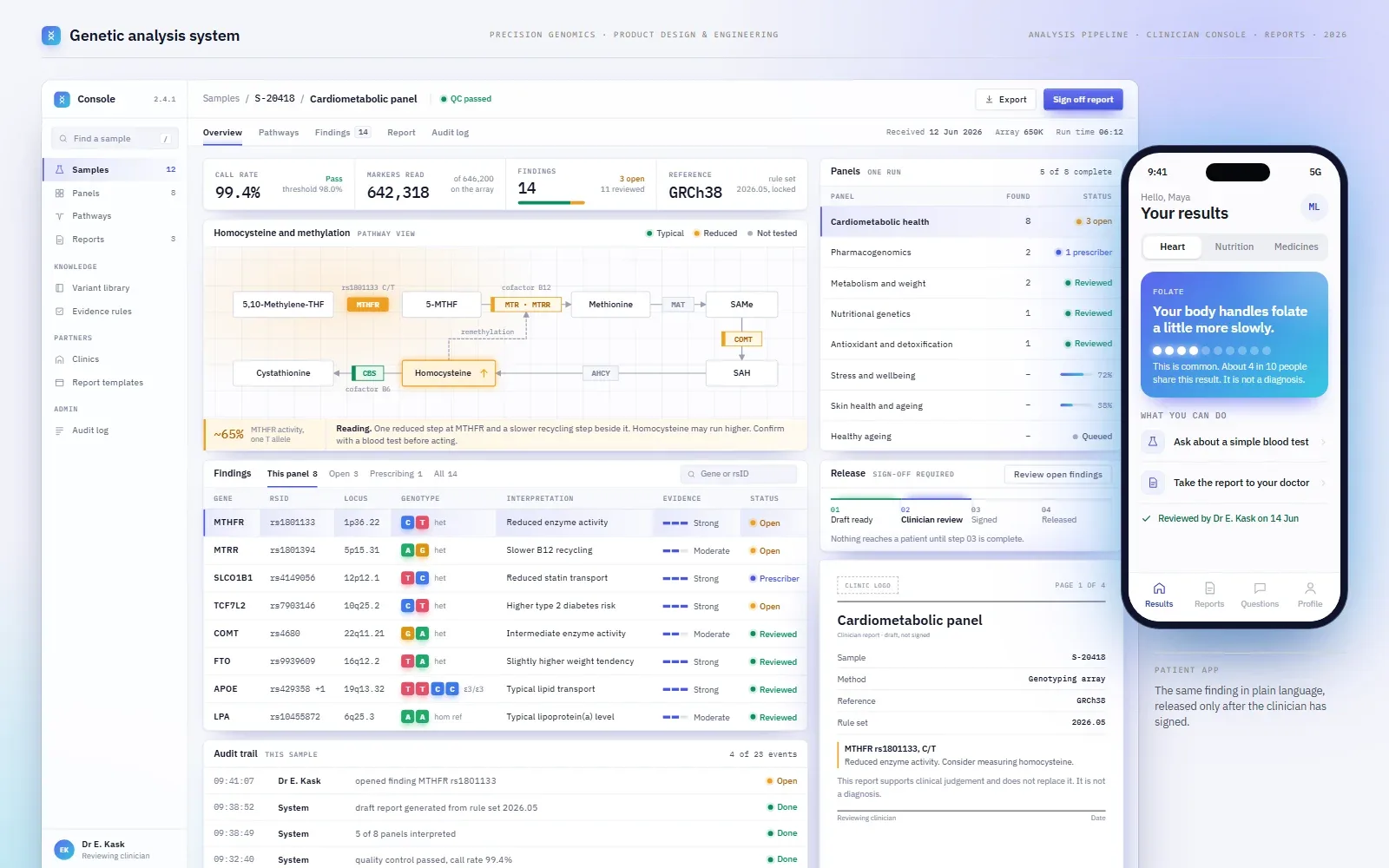
An analysis pipeline, clinician console, and report builder for a precision genomics company: eight health panels from one run, a pathway view doctors can read at a glance, and a sign-off step before anything reaches a patient.
- Health panels produced from a single run
- 8
- Views of every result: clinician and patient
- 2
- Clinician sign-off before a report is released
- 1
- Reports carry the partner clinic's name
- Branded
A precision genomics company needed a system that takes a person’s raw genetic data and produces something a doctor can act on. We designed and built it: the analysis pipeline, the console clinicians review results in, and the reports that go to clinics and patients.
At a glance
- One run, eight panels, from cardiometabolic health to pharmacogenomics
- A pathway view that shows where a result sits in the body’s chemistry, not only a list of variants
- Two views of every finding: full detail for the clinician, plain language for the patient
- A sign-off step, so nothing reaches a patient without a clinician’s review
- Partner-branded reports for the clinics that offer the tests
The problem worth solving
A genetic test produces hundreds of thousands of data points. Almost none of them mean anything on their own, and the ones that do are easy to overstate. A report that lists variants and risk words leaves a doctor to do the interpretation by hand, and leaves a patient alarmed or confused.
The company’s value is in the interpretation. The system had to make that interpretation consistent, traceable, and readable by two very different audiences.
From a raw file to findings
The pipeline checks the quality of each sample before anything else. A sample that fails is stopped with a reason, not passed along with a warning nobody reads.
Each finding is then built from a rule that names its source and its strength of evidence. A clinician looking at a result can see which variant was read, what it is known to do, and how well established that is. When the science changes, the rule changes in one place and every future report follows.
A picture a doctor can read
A list of gene names is hard to reason about. Most findings matter because of where they sit in a chain of reactions, so the console shows them there. In the methylation pathway, for example, a clinician sees which step is slowed, what feeds it, and what may build up as a result, on one screen.
The same view carries a plain reading of what it shows and what to confirm before acting, such as a blood test.
Two audiences, one result
The clinician’s view keeps everything: variant, genotype, evidence, and status. The patient’s view says the same thing in everyday words, puts the result in proportion, and suggests what to ask a doctor. Neither view diagnoses anything, and both say so.
Built so a person decides
The system prepares a draft. A clinician reviews the open findings and signs the report, and only then can it be released. Results that concern prescribing are routed to the prescriber. The software supports clinical judgement and is designed so it cannot quietly replace it.
Because this is genetic data, samples are handled by identifier and access is limited by role. Privacy is part of the design, not something added at the end.
Reports that carry the clinic’s name
Partner clinics offer the tests under their own brand. The report builder applies each partner’s branding to the same reviewed content, so a clinic gets a document that looks like its own without a second version of the analysis to maintain.