A telehealth platform where the AI drafts and the clinician decides.
Product design for a video consultation service: a clinician console, a patient app, and an AI assistant that drafts notes but never prescribes or signs.
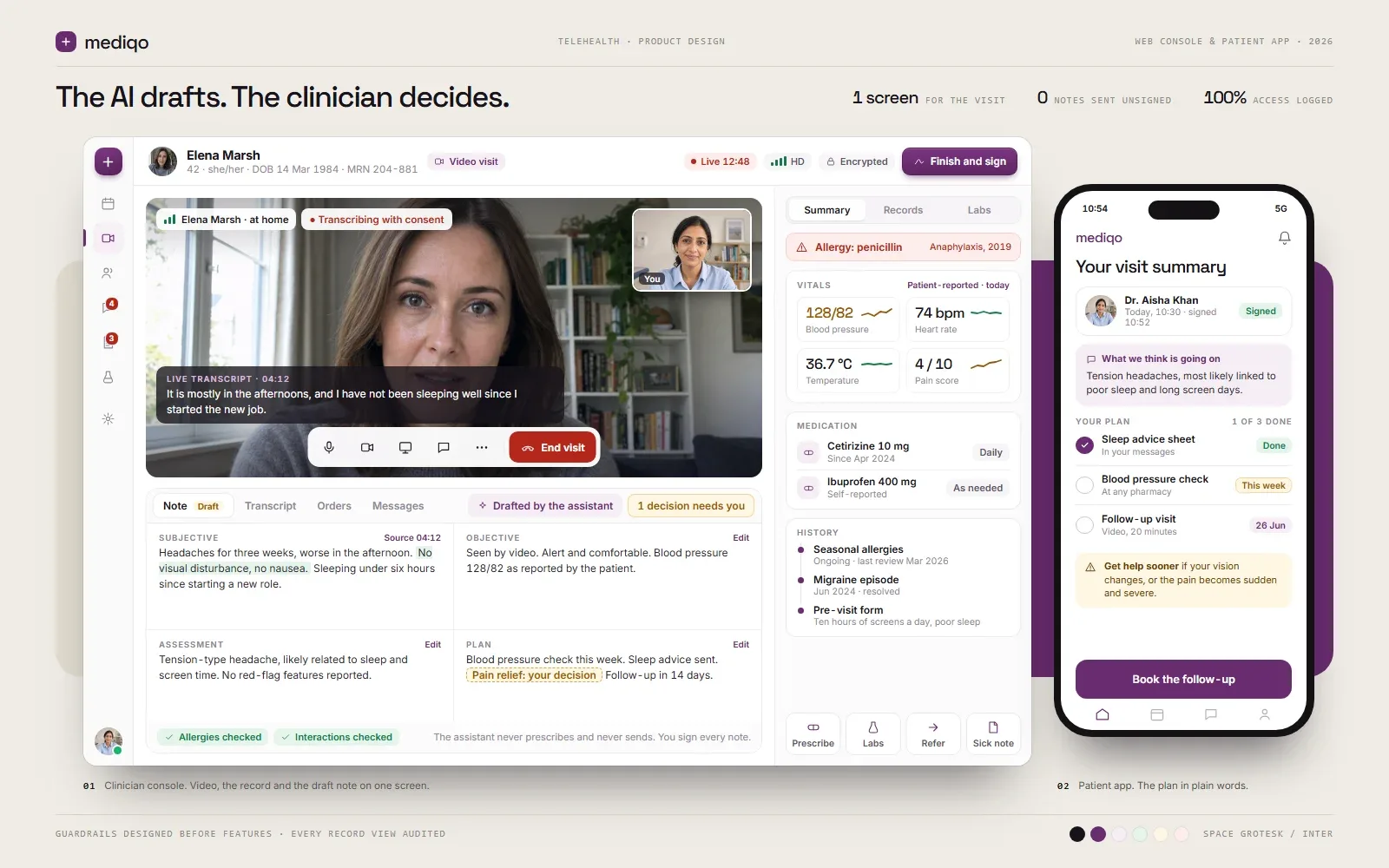
- Products: clinician console and patient app
- 2
- Notes that reach a patient unsigned
- 0
- For video, history, and notes
- 1 screen
- Record access written to the audit log
- 100%
Mediqo is a video consultation service with general practitioners. We designed its two products, a console for clinicians and an app for patients, and the AI assistant that sits between them with a tightly drawn job description.
At a glance
- A clinician console with video, patient history, and notes on one screen
- A patient app for booking, joining the visit, and reading the plan afterwards
- An AI assistant that drafts the consultation note, which a clinician must review and sign
- Audit logging of every access to a patient record
The problem worth solving
A clinician on a video call is doing three jobs at once: listening to the patient, reading the history, and writing the note. The note usually loses, and gets finished from memory at the end of the day. Patients, for their part, leave a call having understood half of the plan.
The design gives the clinician their attention back and gives the patient a written plan they can act on, without ever letting software make a clinical decision.
One screen for the consultation
Everything needed during a visit is on one screen. The video takes the centre. Beside it sit the patient-reported vitals, the relevant history, current medication, and allergies. An alert such as a penicillin allergy is shown in red and can never be collapsed. Ordering a lab test or a referral is one action from the same place.
An assistant with a narrow job
The assistant listens to the consultation, with the patient’s consent, and drafts a structured note and a suggested plan. That is the whole of its role, and the limits were designed before the features:
- It never prescribes and never suggests a dose
- It never sends anything to the patient; a clinician reviews, edits, and signs every note
- Its draft is marked as a draft on screen until it is signed
- Anything it is unsure of is flagged, not filled in
The value is in the minutes it returns to each consultation. The safety is in how little it is allowed to do, and in the interface making those limits visible on every screen.
The patient side
Patients book a slot, answer a few questions, and join the call from the same app. Afterwards the signed summary arrives as a checklist: what to do this week, what was sent, when the follow-up is, and when to seek help sooner. Questions go to the care team as messages with a stated response time.
Designed for health data
Health records carry the strictest obligations of any data. The design assumes encrypted video and messages, role-based access, and an audit log that records every view of a record and cannot be edited. Data residency, retention, and consent are set to the regulations of the market, such as HIPAA or GDPR, before a build begins.
What the design is built to move
Time a clinician spends on notes per consultation, the share of drafts accepted with minor edits, attendance at follow-up visits, and incidents in which the assistant steps outside its limits, for which the only acceptable number is zero.
